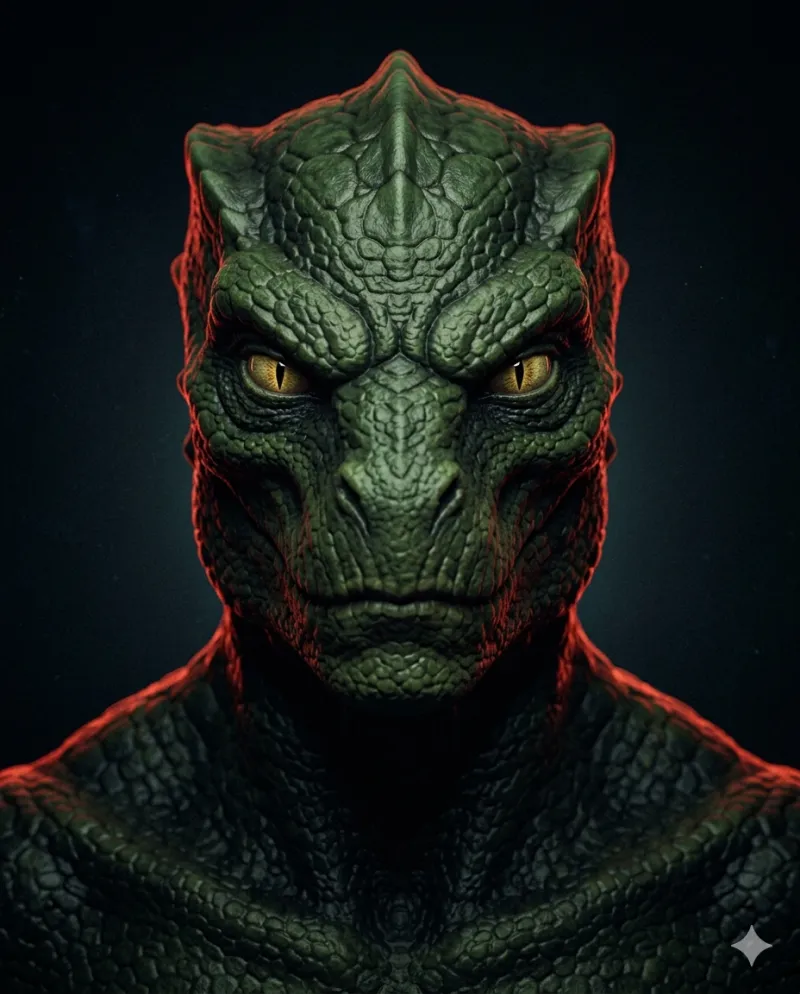
The Reptilians
Towering, scaled, muscular humanoids with vertical-slit pupils, a crested brow, and — when veiled — the ability to project a convincing human hologram over their form.
Every ancient culture that mattered carved the same warning into its stone: a serpent that walks like a man. The Babylonian Anunnaki, the Mesoamerican Quetzalcoatl, the Nāga of the Vedas, the dragon-kings of China. Skeptics call it coincidence. The disclosure community calls it memory.
The modern Reptilian narrative — popularised in the late 20th century — proposes that a saurian intelligence from Alpha Draconis colonised Earth long before mammals inherited it, and that when humanity rose, the Draco did not leave so much as recede: into deep underground bases, into folklore, and into our institutions through hybridised bloodlines.
Whether literal or a mythic mask for very human evil, the Reptilian archetype endures because it answers an uncomfortable question: why does power so often behave as if it does not consider itself one of us?
“The throne was always cold-blooded. We only crowned it.”
Temperament
- ◇Dominant, hierarchical, territorial
- ◇Patient strategists who think in centuries
- ◇Contemptuous of 'unevolved' species
- ◇Masters of fear as a control mechanism
The Agenda
Influence rather than invasion. The lore holds that Reptilians embedded themselves in human bloodlines and institutions millennia ago, steering civilization from behind thrones, banks, and intelligence agencies.
How to know one
- ►Eyes that 'slit' under stress or low light
- ►An unsettling stillness; a predator's patience
- ►Obsession with bloodline, ritual, and control